

Irene as Ellen Olenska
Release date 09.14.1934
“I'm not like these dear, kind people who want to help me. I want my freedom, Newland. I can't pretend…"
“Pretend?”
“Yes, that I'm like the other women over here. They never seem to feel any…need.
…I'm one of those women who must have love…who must be loved.”
(Ellen - in the best scene of the whole film)
In a flashback Newland Archer (John Boles) tells his grandson about his love for Ellen Olenska (Irene) for whom he considered changing everything a long, long time ago…
Newland is engaged to May Welland (Julie Haydon) like him a member of New York's fin de siècle high society. This tradition centered community is entered by May's cousin Ellen who after living for a long time in Europe fled from her husband, and returned to her family seeks for a divorce now.

Ellen surrounded by her family
In the position of her legal adviser Newland gets the chance to talk her out of this, reminding her of the upcoming scandal and what this would mean for the rest of the family -there are more things to think about than Ellen's freedom and happiness. Nonetheless, Newland is touched by Ellen's honest directness and being different from all the other women in his surroundings, and slowly falls for her. Mixed up by these feelings he urges May to change her and her parents' plans and to marry as quickly as possible, which May interprets as a sign that he isn't sure about his love for her and offers to set him free. Something Newland declines thus dissipating May's hunch that he is interested in another woman.

For once alone...
Newland and May get married and embark for a long honeymoon in Europe. As soon as they are back they visit Granny Mingott (Helen Westley) who is kept company by Ellen. From the very first moment when they meet again it's obvious that nothing has changed between the two lovers. At one of their secret meetings at the Metropolitan Museum they decide to go to Washington together, but they make their plans without May and the relatives who started to get suspicious…

at the Metropolitan Museum...
Maybe if I wouldn't love Edith Wharton's novel of the same title on which this film is based, and wouldn't have watched the Scorsese filming of the “Age Of Innocence” a long time ago, I'd like this film better. But as things are, it's simply a bad filmization of that novel. The script deprives the story of all its delicately spun irony, its elegance and even its tragic moments, because the New York society Wharton portrays is one of unspoken dialogues, of undiscussed values and rules and certainly not as outspoken and direct as this film implies. This brings the story at the brink of not working at all because it's hardly understandable why these lovers can't be together. In the book this is all a lot more complicated and embroiled, which makes it understandable and not only an outlived, old-fashioned behavior. The utilization of a frame story in which the grandson in a similar situation decides just the opposite isn't helpful either. Bereft from all its subtlety the “Age Of Innocence” is simply an unhappy, weepy love story.

the last glimpse at Miss Dunne in this film...
Maybe even this could work - I can't say that I don't like a weepie now and then - if we would have a more competent leading man at hand. I complained about the handsome Mr. Boles in “Back Street”, but this time he really gets on my nerves in his one-dimensionality . Every time the miserable lovers meet, Mr. Boles looks at Irene like a wounded puppy, which obviously was meant to be tragic; added to this are corny violins in the background, which certainly is not Mr. Boles' fault, but that's just what I don't need having to face Mr. Boles in one of his emotional moments. Quite helpful once again are the supporting players who are around, especially Helen Westley as Granny Mingott - a real scene stealer - and Laura Hope Crews as May Welland's mother. Watching Irene's films the last couple of months I developed quite a liking for these two ladies.
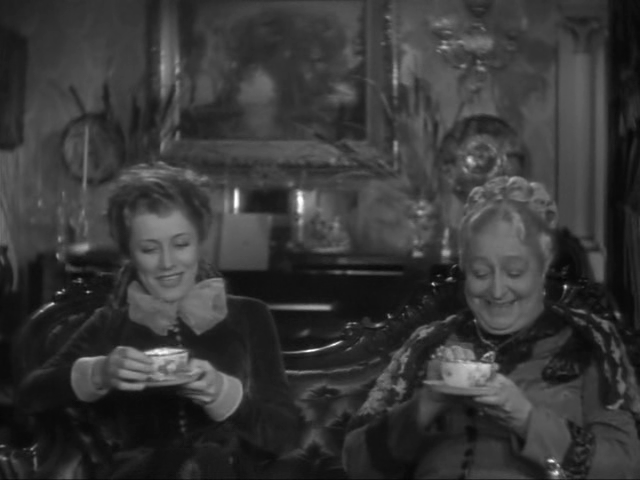
Irene and the great Helen Westley - sharing an onscreen chuckle
This brings me to the lady for whom I'm around - Miss Dunne. Irene mainly gets me in this film - I have to admit this - with her looks. She radiates a warm, melancholy-trimmed, touching beauty, which is a real asset of this film and at last offers some depth and second layers to the goings-on. Her entrance - we have to wait ten minutes before she enters the screen - dressed up for a ball is glamorous and worthwhile waiting for. And there is Irene's lively, expressive face which once again made selecting the screenshots a real pleasure - certainly not my favorite film but good for wonderful photos. However, of course, Irene like the rest of the cast including Mr. Boles has to handle a weak, superficial script and they are not helped by the stiff and uninspired direction of Philip Moeller.

Irene as Ellen Olenska making an entrance and leaving an impression...
Well, it seems I don't like that film very much and what could I say about it?
Read the novel? That certainly would be an idea. And if you want merely to watch a good filming of it, turn to the Scorsese film from 1993 that by the way was nominated for an Academy Award for Best Adapted Screenplay.But if you are intrigued by Irene by now - and I kind of hope for that - switch “The Age Of Innocence” on - just to look at her.


b.jpg)


