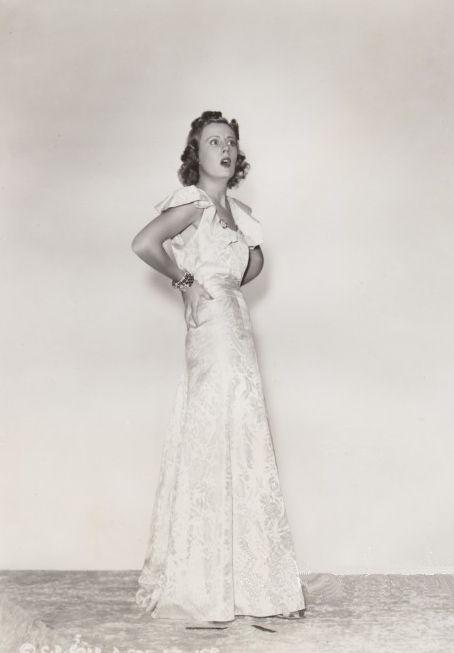
Thursday, June 30, 2011

The Awful Truth - my favorite dialogue


Jerry: In half an hour , we'll no longer be Mr. and Mrs. Funny, isn't it?
Lucy: Yes, its's funny that everything is the way it is, on account of how you feel.
Jerry: Huh?
Lucy: I mean, if you didn't feel how you do, things wouldn't be as they are, would they? What I mean, things would be the same if things were different.
Jerry: But things are the way you made them.
Lucy: Oh, no. Things are the way you think I made them. I didn't make them that way at all. Things are just the same as they always were...only you are the same as you were, too...So, I guess things will never be the same again. Ah,...night.


Jerry: Good night....
Lucy: You are all confused, aren't you?


No, not after I wrote it down and typed it out! 

The Awful Truth

The Warriners

Release date 10.21.1937

Jerry Warriner (Cary Grant) allegedly back from Florida - he never left New York and we won't learn about the why and wherefore - is nonetheless slightly annoyed when he returns to an empyt apartment with a couple of friends. Where is his wife Lucy (Irene)? Entrance Lucy, surprisingly all dressed up and with her handsome singing teacher Armand (Alexander D'Arcy) in tow. Follows the well-known excuse of "the car broke down and we had to stay in an inn," and exactly when Jerry is on the brink to embark on an "I'm in the right" scene caused by jealousy, Lucy discovers that the oranges he brought her are not from Florida but from California! The hasty jump to conclusions of the Warriners ends with a divorce and a struggle about the custody for their dog, Mr. Smith.

arguing over Mr. Smith

Mr. Smith goes to Lucy with visitation rights for Jerry which means that he shows up frequently at Lucy's apartment. While waiting for her final decree, Lucy urged by her Aunt Patsy (Cecil Cunningham), starts dating wealthy Oklahoma farmer Daniel Leeson (Ralph Bellamy). Unsophisticated Dan soon proposes and is accepted by Lucy thus bringing Jerry completely to the scene.

Dan enjoys a hearty laugh...

He does the best he can to disturb the ongoing courtship, and in the proceedings it becomes obvious that he and Lucy are still very attracted to each other. Being a woman and therefore quicker about such things, Lucy knows that she loves this lunatic soon-to-be ex-husband of hers, and we could be heading in the direction of a reconciliation, if Armand wouldn't enter the scene...
Well, completely fed up now, Jerry decides to look for other female company and before long, he is involved with rich socialite Barbara Vance (Molly Lamont). The three months are over, at midnight the decree will be final, and Lucy visits Jerry at his apartment for a last farewell - still hoping that it won't be the last, though.

Sometimes it's hard to be a woman...

Accidentally she picks up the phone, and to destroy the suspicions of his fiancée Jerry passes her off as his sister. Turns out this wasn't such a good idea, because "Sister Lola" gets an invitation to a dinner party at Barbara's parents' house. That's the chance Lucy waited for and she not only shows up, but gives the phrase "to be the heart and soul of a party" a new and very peculiar meaning. To rescue the situation, Jerry drags her out of the house, and taking advantage of the situation, Lucy presses every button to lure him into her bedroom before midnight...

Irene Lola Lucy in action!

Much of the action was improvised and director Leo McCarey wrote parts of the script directly on the set, which gives "The Awful Truth" an unbelievable fresh- and directness. Though he left his actors room for spontaneity, McCarey defenitely knew what he wanted and this shows. Additionally, he had - due to his training in his earlier films - a knack for slapstick, which makes this movie a splendid mixture of witty dialogue and almost banal humor. Bedroom farces, sitting on handkerchiefs, toppling over chairs or other madcap scenery are neither exactly new nor sophisticated but how these situations are handled ,and by whom, cracked even me up  - decidedly more on the verbal side of humor.

The Warriners - slightly seperated

"The Awful Truth", this story about two human beings who get into a divorce not to lose their face and have to make fools of themselves not to lose each other in the end, is a lot, a lot of fun. This exemplary representative of the screwball comedy genre gained Leo McCarey a Best Director Academy Award.
On the set of her second comedy, Irene met the first of her two favorite leading men - Cary Grant (the other one was soon to come Charles Boyer). And as she told in an interview: "We just worked from the first moment. He's a generous actor. He can afford to be, any man that gorgeous, and who'd watch little old me?" (interview with James Bawden) Anyway, "The Awful Truth" certainly offers enough good reasons to watch "little old me." It's Irene Dunne at her comedic best, in an with an Academy Award nomination for Best Actress awarded performance, and if you want to know what all the fuss about her perfect timing is about, you just might watch this film. But of course, all of Irene's timing wouldn't work without someone like Cary Grant as counterpart - quite a master of timing himself that guy!

Little Ol' Me, Mr. Smith and Mr. Generous

If "The Awful Truth" is an example for timing it's as well an example for another difficult-to-explain-but-you-know-it-when-you-see-it term -- on-screen chemistry. Is it that the actors seem to be at ease with each other and at the same time there is an erotic tension? Is it repartee? Or simply bringing out the best as actors in each other? Seems to be all of this and a lot more!
However, what I simply love is Irene's and Cary's constant ogling each other. They react to their -once again expertly arranged entourage - and concurrently have a steady sort of private interaction going on. Irene Dunne and Cary Grant simply were a perfect match, last not least in their similar style of acting which looks so effortless and natural and was unfortunately of the Award Nominations amassing and not winning the statuette kind.
Those two human highlights are competently supported by Ralph Bellamy in one of these rather thankless  "the third part of a triangle" roles. But Mr. Bellamy - an utterly sympathetic actor - gives a charming performance, and his dance number with Irene, for which he had to practice a lot, is one of the (many) high points of the film.

Lucy and Dan trying a step or two...

Surprise, surprise! I love this film, and every time I watch it I discover a new facetious detail and an Irene qoute comes to mind: "It is difficult to make people laugh, but it is infinitely worthwhile. You have lengthened their lives, or you have made them happier, and that is important in itself."(The Sydney Morning Herald, June 1938) If this is true - and I have no reason to doubt Miss Dunne - I certainly owe Irene!

one of my favorite publicities
                                                         
 Some last words about the core of this blog - the one and only Miss Dunne. I'm convinced that Irene could have managed a career without any comedy ventures. She already had her place in Hollywood, and could have gone on solely with melodrama and musical, but I certainly like how the comedies broadened her image. This new genre offered her the opportunity to show some more facets: her sense of humor, youthful lightness, this delighful playfulness and last not least the simple fact that she was indeed a dish. The days of philandering on-screen husbands and lovers are gone by now - no more fighting for men but with relish fighting with them. And sex appeal, humor, warmth, the most wonderful throaty laugh and the steady impression that this woman is up to something make quite a nice armory in the battle of sexes.

Good night!

Monday, May 30, 2011

High, Wide And Handsome

Our handsome couple - Irene and Randolph Scott 

Release date 07.21.1937

"Can I forget you? Or will my heart remind me that once we walked in a moonlit dream?...
Will the glory of your nearness fade, as moonlight fades in the vail of rain?
Can I forget you, when everything reminds me how much I want you back again."

Today is an evening of entertainment for the little Western Pennsylvania town, because a medicine show visits the community. While Sally Watterson (Irene) sings her father (Raymond Walburn) tries to sell his universal remedy to the inhabitants; that their wagon catches fire is an unintentional enrichment to the spectacle and leaves Sally and her father stranded. Fortunately handsome farmer Peter Cortland (Randolph Scott) is at hand, and he and his grandmother (Elizabeth Patterson) take the homeless, "wagonless" folks in. Well, to build a new home on wheels needs some time, at least enough for Sally and Peter to fall in love.

The medicine show

Peter, who in his spare time drills for oil, exactly hits a well on their wedding day and the festive gathering is completely drained by an oily rain. Something similar happens to Sally and Peter’s marriage – preoccupied with the petroleum boom which spreads over the land, Peter neglects his wife. All gets worse when the farmers under the guidance of Peter try to boycott the railroad company that blackmailed them into immense freight rates to get their oil to the refineries. Looking for another way of transportation Peter has the idea to build a pipeline, an enormous project, which not only costs him his whole time but the hill where he and Sally wanted to erect their future home. That´s the last straw for Sally and she runs away with a Carnival show… follows a lot of action!

Sally enjoying the pleasures of a real home...

Romance, oil boom, David versus Goliath fight, carnival shows, saloons and shanty bars, barn dances, pipeline construction, marriage troubles, fist-fights, not to mention a couple of beautiful Kern numbers – those are busy 145 minutes. In less capable hands this could have been a disaster of a film but as things are "High, Wide And Handsome" was in just the right hands. In an interview, Irene described director Rouben Mamoulian as a sort of detail fanatic, and this definitely paid off. One beautiful visual tidbit follows the other, and the way how we are thrown into the story – with a close-up of singing Irene – is certainly a treat. How Mamoulian uses the lighting or the effect of showing us a detail at first and then slowly moving back and thus giving way for the whole scenery is worthwhile a closer look. Unfortunately this movie is only available in a blurry print, and I’d love to watch this in a cleared up version and on a real big screen. Mamoulian’s craftsmanship of direction is equally competent and winningly completed and supported by our leads.

Irene and Rouben Mamoulian (with jacket) waiting for the perfect cloud constellation.
In the film that's a very, very short scene but the clouds in the background are simply beautiful!

Not exactly youngsters anymore – both Irene and Randolph Scott were in their late thirties in 1937 – they pull off a touching "young love" and make a very handsome, tender couple. Initially this production was planned with Cary Cooper in the male lead but Randolph Scott took over at short notice. Though I’d appreciate an association of Irene with Cary Cooper because of name dropping reasons, I certainly don’t miss him here. Mr. Scott gives a fine performance and he and Irene complement each other nicely. Irene, who didn’t like that film very much due to several reasons one of them being that her mother died during production, needed the distance of some decades to reconsider her judgment on "High, Wide And Handsome", and to some degree appreciate the film and Randolph Scott’s performance: "I saw it on television here some weeks ago and I didn´t think it was half as bad as I remembered it…But Randy Scott was so much better than I remember him being." (full interview) I hope this new point of view included herself because Irene’s breezy performance is darn joyful to watch. She was indeed too mature for the role – in the last analysis, only counting the years, Irene was too mature for many of her films  - but it simply doesn’t matter.

And here, they are again!

And of course, it’s the combination Dunne-Kern again. Only after I worked on the theatre page for my Irene Dunne website, and hence listened to a lot of the music of that time in the original versions, I fully understood how beautiful Kern’s songs are for Irene’s voice. Her classical educated voice, which sometimes was – and still is for some people – unfamiliar singing "popular" music, shows all its advantages in Kern’s compositions. Especially beautiful is "The Folks Who Live On The Hill" ending with some impressive high notes and deservedly the best known song from "High, Wide And Handsome." Irene obviously loved singing, and to encounter this pure, direct joy coming from a performer whose forte is based on an ultimate, intelligent soberness and rationality is always a wonderfully striking moment.(Here are those songs, and don't miss Irene's live version of "The Folks Who Live On The Hill" in the misc. section of the same page) 

Irene on the set of "High, Wide And Handsome"

Well, a varied story, skillful direction, captivating performances – including the supporting cast, which offers such names as Charles Bickford and young Dorothy Lamour – and Jerome Kern and Oscar Hammerstein in charge of the score, who could ask for anything more? The whole certainly sums up to a gladdening, though sadly underrated piece of entertainment, and shouldn’t be missed.

Saturday, April 30, 2011

Theodora Goes Wild


Irene as Theodora Lynn

Release date 11.12.1936

"You know, what your aunts wired?"
"Those two delightful relicts? No. What?"
"Theodora's gone wild!"
"Tut, tut, I haven't started."

Welcome to Lynnfield, a small quiet New England town! But today Lynnfield is in an uproar about the first installment of a racy novel published in the Lynnfield Bugle. The protest is headed by Lynnfield‘s literary circle and especially by its important members Mary and Elsie Lynn (Elizabeth Risdon and Margaret McWade), off springs of the founders of Lynnfield and spinster aunts of Theodora (Irene). What the aunties, who educated Theodora, don't know is that her niece, proper Sunday school teacher and church organist, wrote this novel under the name de plume “Caroline Adams“. To avoid any further scandal Theodora goes to New York to instruct her publisher (Thurston Hall) to keep her identity a secret. In his office she meets artist Michael Grant (Melvyn Douglas) who illustrated the cover of her book, and Michael, quite surprised by the prim looks of alleged wild Caroline Adams, starts challenging her “to let her back hair down“.

Michael (Melvyn Douglas) testing out "Caroline Adams"

Theodora's attempt to pick up the gauntlet and to show that she is indeed an experienced woman ends with an escape from Michael's apartment. Michael's interest is aroused and he follows Theodora to Lynnfield where he manages, with a lot of talking and threatening Theodora to reveal her secret, to get a job as gardener in the Lynn's house. Michael views it as his mission to rescue Theodora from narrow-minded Lynnfield and to help her to live her own life - as free and self-determined as his own. First steps seem to be to urge Theodora to go berry picking and fishing with him, and our two leads have quite a good time in the woods.

Theo and Michael

Soon the townspeople, Aunt Elsie, and Aunt Mary are suspicious of this flowering relationship and the consensus is to send this strange gardener away. An angry Theodora tells them off and admits that she loves Michael, and never will sent him away. Michael is not exactly glad about this announcement and the next day he is vanished, merely leaving a note for Theodora. But Theodora doesn't give up as easily as that; she follows Michael to New York where she learns that a. he is in love with her and b. he is married, trapped in an unhappy marriage, which he doesn‘t dare to break up because of the political ambitions of his father. Theodora vows to free him as he freed her, and if this needs a scandal to hasten the end of his marriage, that can be arranged. Dressed in a new wardrobe Theodora starts living Caroline Adams' life…Theodora goes wild!

Theodora Lynn aka Caroline Adams

I have a little weakness for this film because it was the first Dunne film I watched, and I only picked this one because I wanted to have a look at Dunne and found that title rather promising. Cannot say that this lady knocked me off my feet immediately, but obviously, I considered her interesting enough to check out some more of her films, and well, the rest is history. Some of Irene's comedies make me laugh over and over again, but that's not the case with “Theodora”. The kind of humor offered here, more rooted in the initial situation and clash of culture than in a witty script and the leads' repartee and chemistry, wears thin by and by with re-watching. Nevertheless, there is one scene that always works for me - when Theodora after her transformation turns up the first time at her publisher's office. This toying with layers, Irene Dunne playing Theodora, playing Caroline Adams - which is btw perfectly done by Irene, never loses its effect on me. Though this is not a comedy, which finds me screaming with laughter, it has nonetheless some pleasures ready for me.

Starting to free Michael...

I like the structure of "Thedora Goes Wild"; the contrast between country and city, which, interestingly enough, each are gender dominated. Lynnfield seems to be a town almost completely in female hands, and the city, New York, is run by males. No wonder that New York stands for freedom and the “real” life. That Michael, the embodiment of city life and its principles, has his own skeleton in the closet and is far away from leading the self-determined life he bragged about, brings to light that clichés are just that - clichés. Many things happen two times only with reversed signs, a typical comedy element, and almost all characters are not what they seem to be at first sight. Hillbilly Theodora throws overboard all her Sunday school attitude to get her man, before the altar, though; self-contented Michael loses all his composure and even the maiden aunts are good for a surprise.

Theodora and the "two delightful relicts" (Elizabeth Risdon and Margaret McWade)

“Theodora Goes Wild” was Irene's first genuine comedy, although there are comedy moments to be found in her earlier films. She claimed that she was very nervous during production and that could explain her - for Irene Dunne's standards - slightly over the top performance. Fortunately, this works in advantage for her, because Irene's character is not wild, just pretending to be, and that nervousness adds the needed air of insecurity to make this pretense believable. After all those heavier films it's plain and simple enjoyable to watch twirly Irene fluttering her eyelashes. However, this performance captured Irene her second Academy Award nomination; maybe her peers were simply surprised that Miss Dunne could do comedy. But one shouldn't forget that Irene Dunne had quite a lot of experience with the genre of musical comedy before she ever set her foot on a Hollywood lot.

Okay, let's do a comedy ...

The famous Dunne timing is not in full swing yet, probably due to the fact that this needs a counterpart, which is not given in the person of Melvyn Douglas. I have a special liking for Mr. Douglas - he worked with all my favorite actresses and I always liked what he did - but he and Irene are not the most convincing pairing. I believed her that she fell for him but his confession of love came totally out of the blue. They don't have the greatest dialogue at hand to start with, still some chemistry, some erotic sparkles could have enhanced even this one. Of course, on-screen chemistry is always a rare, lucky occurrence - and maybe I'm simply spoiled because I know of the leading men to come.

At last - a hymn!

And wouldn't you know, Irene sings again! The hymn “Rock Of Ages” illustrates Theodora's position in Lynnfield's community, and is at the same time a nice Irene Dunne tidbit, because singing in church was the way how teenage Irene earned her very first money. And there is Michael's and Theodora's “torch song” titled “Be Still My Heart”. We hear this song the first time in Michael's apartment where Michael imitates a seduction scene from Theodora's novel. Here “Be Still My Love” is used as soft music in the background; the next time it's played by Theodora to silence Michael, and in her interpretation the song sounds like a hymn with the lyrics of a love song, though. The third time “Be Still My Heart” is already a shared memory, thus the triple use of this song makes a nice background commentary to the development of our leads' love affair.

Lynnfield's literary circle (standing Spring Byington)

A real asset of this film are the wonderful performances of the character actors and actresses, especially the townspeople headed by Thomas Mitchell as newspaper man, Spring Byington as the gossip and Elizabeth Risdon as Aunt Mary. Their performances and the fact that director Richard Boleslawski had a knack for crowd scenes lay on a couple of funny moments.

This movie is not one of the most brilliant stars glittering at the comedy heaven, but it's a thoroughly likeable picture - especially if you watch it for the first or second time. As for Irene, “Theodora Goes Wild” is a "must see" because it marks her first comedy and venture into a genre that turned out to be from great importance for her career.

tut, tut, I'm finished!

Tuesday, March 29, 2011

A Pause Before We Are Heading For Comedy

the radiant Miss Dunne in her mid-forties

Although we are only in 1936 and there are still 16 years to come of Irene Dunne in the movies, we are halfway through with our journey. In her first 6 years in Hollywood, five of them under her initial contract with RKO, Irene made about the half of her total of 41 films. This sheer amount deserves a look back before we are going to leave for the second half.

Today Irene Dunne is mainly remembered because of her comedies and as co-star of Cary Grant, which is justified and unjust at the same time. The expression “versatility” is never far away as soon as the name Irene Dunne is mentioned and the fundament of this is her early work. We have melodramas, musicals, conversation pieces in quick succession, and even a western and such an oddity as “Stingaree” found their place. Irene did sing Jerome Kern, opera, music hall ditties; played shop-girls, opera singers, a countess, a fashion designer, a steel mill worker's wife, a secretary and well-off Mrs. Jim Dunlap, just to name a few. In a year like 1934 movie-goers had the occasion to watch Miss Dunne in such diverse motion pictures as “This Man Is Mine”, “Stingaree”, “The Age Of Innocence” and “Sweet Adeline”, thus “Irene Dunne could do it all” was basically established in those early years. And another fundament was laid during that period, Irene's screen persona: ladylike, decent, a vital truthfulness. Those elements - versatility and a defined screen persona - were the ground to build on the next years of Irene's career.

Miss Sophistication in 1941

This ground was effectively, successfully and gratifyingly tilled in Irene's time as a freelance actress. Of course those years gave us the highlights and - not always but most of the times - the superior films. One reason for this is the simple fact that Irene worked with co-stars of the same league as herself; such names as Cary Grant, Charles Boyer - Irene's deservedly so favorite onscreen partners - or William Powell and Spencer Tracy only crossed Irene's path starting with 1937. This second career half bestowed us with wonderful scripts, an impressing list of accomplished directors and last not least a throughout beautifully presented and photographed Irene. Her image in those years is seamless, and the fact that Irene had her hand in picking scripts, the freedom to reject projects and director's approval certainly was part of this. Additionally Irene conquered the genre of comedy, which was the perfect playground to bring her delightful screen persona into full bloom. Especially the comedies took advantage of Irene's on screen and kindly correlating off screen image and deliberately spoofed it with Miss Dunne voluntarily going along.
In her forties, at an age when many actresses have to face a lull in their careers, Irene Dunne was flying high; her success at the box office reflected by her top spot on the list of Hollywood earners.

Those are all good reasons to concentrate on this later phase of Irene's acting career but this would be too narrowly considered. One shouldn't forget that Miss Dunne was already a star before she embarked on comedy; and though most of those early films don't offer the sophistication, wit, finesse of their follow-ups they offer indeed a lot of quintessential Dunne acting and singing. 

Irene Dunne And "Show Boat" Part 2

Irene, an ingenue once again...
                                                          
It seems I have to expand the last post, according to a newly published interview, Miss Dunne did indeed love her version of “Show Boat.” Obviously she had the chance to rewatch this film after she spoke with John Kobal and changed her opinion of it.
The author, film and TV critic James Bawden, talked to Irene several times in the 70s, starting with a visit at her home in 1974 and some telephone conversations as follow- ups. In 1977, this amounted to the article “A Visit With Irene Dunne” for “American Classic Screen” . Apparently Bawden did not use all of his material and compiled the highlights of his talks with Irene to the aforementioned interview. Here is the part about “Show Boat”:

BAWDEN: You´ve said “Show Boat” (1936) was one of your favorite films.
DUNNE: Well, I had played Magnolia for years in New York and on tour. The 1929 (first movie) version was terrible. They used a “new” score. “Junior” Laemmle, who was running Universal by then, had to make (her version, the first remake) by the end of the 1936 or lose the rights, so we worked day and night on it. Yes, I do accept that I was at least 10 years too old by then, but movie magic made me an ingenue once again. Our version (1936) had Paul Robeson and Helen Morgan from the original. But when they told me that Jimmy Whale was to direct, I initially balked. He had done “Frankenstein.” It was sheer, exhausting fun making it, but the cost overrun tremendous. Junior just fell in love with the material and couldn´t stop pouring money into it and , while very popular, just couldn´t make back its costs. Junior lost control of the studio because of it. Only little Deanna Durbin saved the studio from completely folding. (Later) MGM got the rights and suppressed our version and announced (a new version) as a (Jeanette) MacDonald - (Nelson) Eddy vehicle, which wouldn´t have worked. (MGM ultimately remade “Show Boat” in 1952 with Kathryn Grayson and Howard Keel.)

A couple of years ago they found a … print (of her 1936 version) and made a new negative and showed it at a festival and it really does hold up. It´s one I´m very proud of.

Irene mentioned that she really liked only sixteen of her 41 films, never exactly naming the titles, which keeps us still busy trying to figure out all her likes and dislikes. Of course we know about most of the films, and I personally found her disfavors always comprehensible but “Show Boat” was the exception to the rule. So it´s good to know that Miss Dunne was deservedly proud of this one.
Credit where credit is due!

Monday, February 7, 2011

Detour - Irene Dunne And "Show Boat"

Irene 1929 in "Show Boat"

“Show Boat” certainly had a special place in Irene´s career. In 1929 she entered the first road company of “Show Boat” as Magnolia – with great success – and this engagement turned out to be her catapult for a Hollywood career. There are different versions of how Irene managed to snatch that role, but I like the one she told herself in an article titled “Hats, Hunches And Happiness” from the year 1945:
 A few years later, in New York, a blue hat did it again. Any young girl aspiring to a theatrical career held Florenz Ziegfeld in awe. When I found myself riding in a lift with the great showman, I was too much too frightened even to look at him, much less get off at the same floor. Imagine my surprise when a few minutes later, I discovered a young women calling after me.
"Stop, stop," she called, "Mr. Ziegfeld wants you, you, the girl in THE BLUE HAT!"
Show Boat was the result.
Anyway, blue hats, just a simple audition or whatsoever, all of this would have ended in nothing without the needed talent, skills and ambition, and certainly not in a long term Hollywood career.

Beyond the fact that her participation in Show Boat proved to be the decisive step towards a Hollywood career, Irene had a personal, emotional approach to the subject of life on the Mississippi and steamboats. Her father, Joseph Dunn, was a supervising inspector of steamboats and one of Irene´s fondest memories of her childhood was a trip with her parents she made down the Mississippi from St. Louis to New Orleans. Irene´s father is described as a wonderful story teller, full of exciting stories on the life on the Mississippi and Ohio Rivers, and knowing every boat and bayou. Joseph died when Irene was only fourteen, but nonetheless he proved to be a formative influence for the daughter of his. Miss Dunne, surely not the most outspoken person when it came to her personal life, spoke frequently about him – a sure sign of his importance.

Perhaps this very personal background and the fact that Irene knew the musical “Show Boat” backwards, are the reasons why she didn´t like the film very much. She certainly had definite ideas about this production, and in her opinion James Whale was “more interested in atmosphere and lighting and he knew so little about that life” and she added “No, I never cared for Show Boat (the film), but I thought the stage production was one of the best things. The score was marvelous, but even the book could have stood up on its own.” (interview with John Kobal, 1972).
This is something I regret, but Miss Dunne´s dislikes put aside, the film made the number 24 of the American´s Film Institute´s list of best musicals in 2006, and a place on my personal list of favorite Irene Dunne films.

Show Boat

Irene as Magnolia 

Release date 05.14.1936

“Fish got to swim and birds got to fly, I got to love one man till I die,
 can't help lovin' dat man of mine…”

Great turmoil in town: the showboat “Cotton Blossom” is going to land! The variegated troupe of artists pouring from the boat is headed by captain Andy Hawks (Charles Winninger) and his bossy wife Parthy (Helen Westely). The third member of this family is teenage daughter Magnolia (Irene) who meets gambler Gaylord Ravenal (Allan Jones), and instantly falls for him.

meeting Gaylord (Allan Jones) - and singing a duet with him

Magnolia's closest friend on the boat is leading lady Julie LaVerne (Helen Morgan) who gets in great trouble when an ex-friend out of jealousy denounces to the sheriff that she as a mulatto is married to a white man, which is against the state's law. Julie and her husband flee, and as things go Magnolia and Gaylord -looking for a ride on the boat to keep out of jail - take over the leads. No wonder this pair is a success because as lovers they play a couple in love,and soon the wedding bells are ringing and drowning out Parthy's strident protest.

ding-dong

Though he is deeply in love with his wife, Gaylord isn't reformed, and while Magnolia is giving birth to their first child, he is gambling. On a lucky streak he leaves the showboat with Magnolia and their little daughter Kim, and takes them to Chicago. But as we know lucky streaks are not for a lifetime, and after a couple of years Gaylord leaves his family hoping that they are better off without him.If he hoped that Magnolia would simply turn to her family again, he is all wrong. Instead she is determined to make a living for her daughter and herself singing… a lot more to tell, but that would be all spoilers and so I just won't!

Irene surrounded by three members of this wonderful cast:
 Paul Robeson, Hattie McDaniel and Helen Morgan

Sentiment, beauty, laughs, atmosphere, an absorbing plot and an “evergreen-heavy” score - all of this achieved by a wonderful cast under the firm direction of James Whale - who could ask for anything more? With the exception of the end, this 1936 filming of the musical by Jerome Kern and Oscar Hammerstein II based on Edna Ferber's novel, follows the stage production closely, no wonder considering the fact that the screenplay was written by Oscar Hammerstein II. Ten numbers from the original score were actually sung, four were especially written for the film. The cast is mainly consisting of actors and actresses who had on stage experience with “Show Boat” and they obviously knew their vehicle. In particular worthwhile watching is the first half of the film, the part which actually plays on the showboat. From Paul Robeson's pivotal interpretation of “Ol' Man River” to Charles Winninger's tour de force acting out all parts of the hilarious showboat play on his own, numbers like “Can´t Help Lovin' Dat Man” with Irene breaking into a shuffling and trucking step, or Magnolia's and Gaylord's first encounter ending in “Make Believe” - it's all there.

and the great Charles Winninger, here rehearsing a love scene
with our two leads

In the end the film gets a little bit hasty – director James Whale had to cut some scenes - and this shows. Regrettably, one scene which ended on the cutting floor was Gaylord and Magnolia singing “Why Do I Love You?” on a trip with an automobile. Of course Irene, already in the second half of her thirties, didn't look like a teenage girl anymore, but she emanates the air of youthfulness, something she accomplishes mainly through her way of moving. Magnolia is an interesting role with a wide range of emotions – no problem for Miss Dunne who knew this part back and forth. As you know by now, I have quite a weakness for Miss Dunne's singing voice, and once again she doesn't disappoint me, neither does the rest of the cast – Helen Morgan's touching version of “My Bill” certainly deserves an extra mentioning.

and that´s our lost chance of hearing "Why Do I Love You?"

Meritedly, this second screen adaptation of Show Boat – first filmed in 1929 as semi-talkie production, remade in 1951 by MGM as a Technicolor musical – made it to the list for preservation in the United States National Film Registry by the Library of Congress, but we are still waiting for an official DVD release, at least rather good TCM rips are around. Though the film is on YouTube, I highly recommend watching it on the biggest screen you have at hand – this film simply cries for a big screen.
Well, have a wonderful time visiting the “Cotton Blossom”!

Monday, January 3, 2011

Magnificent Obsession

Irene as Helen Hudson

Release date 12.30.1935

"He said, he couldn´t take it back because he had already used it up.
Then he told me to invest it myself.
When I asked him, what was a safe investment. He said:´Any poor devil!´ "

Helen Hudson (Irene) loses her husband to a heart attack because the for the rescue of Dr. Hudson necessary pulmotor resuscitator was at that time used on Bobby Merrick (Robert Taylor), a playboy on a drunken binge. Dr. Hudson was a renowned, honored surgeon with a hospital of his own, and soon his widow learns about his many secret philanthropic efforts.
After Dr. Hudson’s death his beneficiaries feel relieved of the promise they gave him never to talk with anybody about his help, and express their gratitude to Helen. This reveals Helen even more how deep her loss is,and how much she hates Bobby Merrick. Of all things, Bobby ended up in Dr. Hudson’s hospital, and though he feels guilty that he was saved and the doctor was not, his main concern is to get out of this place and search for some distraction. Fleeing from the hospital, he meets - of all people - Helen and not knowing who she is keenly starts flirting with her.

Bobby Merrick (Robert Taylor) and Mrs. Hudson

Helen reacts slightly annoyed, but as soon as she discovers the guy’s identity, she denies any further contact. Not getting his way, Bobby Merrick once again turns to the bottle and this time ends up in a ditch at the house of Randolph (Ralph Morgan). Randolph happens to be one of the persons Dr. Hudson helped to find their right place in life. He tries to introduce Bobby to Hudson’s philosophy of secretly helping people and thus making contact with an allmighty power. Once accustomed to this style of living this will become a "Magnificent Obsession". Giving it a try, Bobby feels rewarded when he meets Helen. Angered by his once again starting flirtation Helen flees, and is run down by a car. Helen survives the accident but is blinded.

fate strikes a second time...

Feeling guilty, Bobby Merrick tries to help Helen supporting her secretly financially, and arranging for specialists to examine her in Paris. He manages to introduce himself as “Dr. Robert” to her, and Helen not recognizing his voice, slowly falls in love with him. The examination in Paris ends with a negative result: at the moment there is no chance for a surgery to restore Helen’s sight.

No hope...

At this low point of desperation Robert turns up, not only showing through his eyes Paris to Helen, but also proposing and revealing his real identity. Well, the next day, though she is in love with Robert, Helen is vanished, because she doesn’t want to be a burden to him. All attempts of locating Helen are in vain, and ultimately Robert returns to his studies. After six years abroad, he returns to the United States as esteemed surgeon and soon learns that Helen lies in a hospital. Her condition is life threatening and only a risky, complicated operation can help…

Helen and Bob doing Paris...

“Magnificent Obsession” is a very beautiful film with an option for being grand which the picture not completely fulfills. Considerable screen time of this for its time rather long film - 112 minutes - is wasted on distracting actions. Especially Charles Butterworth, in one of his typical funny sidekick roles, takes up some time. This wouldn’t be much of a problem if I wouldn’t feel deprived now and then- deprived of imaginable, wonderful screen moments. Why, with an actress like Irene Dunne at hand, don’t I get a dramatic scene in which she explains to one of her companions why she can’t except Robert’s proposal? Instead, her character just plainly drops out of the action for about ten minutes. Why is the happy interlude so short? Moreover, where is my Irene Dunne close-up in the last scene? I really waited for this one, and all I got is Irene stuck in a frame with Robert Taylor. As much as I liked Stahl’s directing in “Back Street”, all he offers here is solid, but that’s as far as it goes. At times the film kept me too much at a distance instead of directly aiming at my tear glands. This wouldn’t matter, if the alternative to having to fill many story gaps and not following the characters we are really interested in, wouldn’t be Mr. Butterworth.

Miss Dunne and Mr. Taylor inhabiting the same frame...

That said, let’s concentrate on the reasons that make “Magnificent Obsession” a worthwhile our attention film, namely especially two: Miss Dunne and Mr. Taylor. Irene recommended Robert Taylor - at that time at MGM and not yet a “name” - for this role, and this was not only a nice boost for his career, but also the perfect choice for the film. Irene who always had the attitude that “it is the picture at a whole and not only the star, which determines box office success” helped Taylor, encouraged him and rehearsed lines with her co-star. Robert Taylor proves that he was worth this support by giving a fine, subtle performance making the development of his character as believable as possible. Especially in the beginning, he manages to show boyish charm, good-for-nothing behavior, real honesty and likeability in quick turns: the possibilities for his character all are there to start with. All of this sums up to a coherent, convincing presentation of a human being and some great Irene Dunne-Robert Taylor scenes.

one of those beautiful publicities for "Magnificent Obsession"

As for Miss Dunne, “Magnificent Obsession” illustrates the quintessence of her acting. Now under a short term contract for Universal - after “Roberta”, Irene left RKO, never again picking up such a sort of studio contract again - Irene prepared as consummate as ever for her role as a blind woman. She worked with a blind consultant on how to walk and carry herself as a sightless person and this definitely came to fruition. She gives the perfect portrayal of a blind woman and Irene did not - like Jane Wyman in the remake - take the easy way by simply wearing sunglasses. Playing a woman who has lost one of her five senses, Irene turns even more than normally to expressing herself by the skillful use of  her speaking voice. Anyway one - maybe the - outstanding forte of her acting, she plays on her voice like an accomplished instrumentalist. And the part of Helen Hudson really offers something to play with: emotions in a range from A to Z, quick changes from desperation to happiness - no wonder Irene preferred drama to comedy because of challenges like that. Just listen to Miss Dunne in the last scene - lying in bed, after surgery with a bandaged head, that’s not the moment for grand acting, but Irene expresses everything: feeling strange, tiredness, joy, excitement…and all of this with a half-anesthetized, muffled voice. Simply wonderful!

this scene is not in the film - obviously the original happy interlude was longer!

The Dunne of “Magnificent Obsession” is the Dunne of the coming soon comedies; some habits which are “typical Dunne” and part of Irene’s delightful comedy persona are already at hand. Her slightly wiggling shoulders, the fast moving eyelashes and even this characteristic, throaty, very-difficult-to-describe, marvelous Dunne laughter are around.
A recommendation of “Magnificent Obsession” goes without saying - not only as terrific Irene Dunne vehicle but as exemplary representative of the 30s melodrama and last not least as early Robert Taylor film.
The last thing to mention is one of my beloved details: while dressing to “do Paris” with Robert, we hear Irene sing off-screen. Sometimes the perfect expression of happiness is singing! Thank you, Miss Dunne!