Wednesday, October 20, 2010

Sweet Adeline

Sweet Adeline 

Release date 12.29.1934

“You know, I can't do it…it's off!…
And there is Pop. I would kill him! A painted woman! A stage actress!!”
(Adeline to Sid)

Adeline Schmidt (Irene) works in her father's beer garden and is courted by two men: aspiring composer Sid Barnett (Donald Woods) and Spanish-American War Army Major James Day (Louis Calhern). Of course sweet Adeline is not only a waitress but an accomplished singer for whom Sid's songs are written and thus he tries to persuade her to star in the upcoming production of his operetta. Knowing that her father dislikes all things theatre Adeline refuses, which ends with a quarrel between Sid and her, and Addie starting to date the Major.

Adeline and Sid - prelude to a quarrel

Well, the role goes to Elysia (Winifred Shaw) whose wealthy boyfriend Rupert Rockingham (Hugh Herbert) conveniently will back up financially for the show. Adeline's nutty sister Nellie (Nydia Westman) is suddenly vanished from the beer garden, and Addie searching for her - of course with the Major in tow - happens to show up at the perfect moment at a rehearsal of the operetta. To make it short: Adeline sings and snatches  away the lead from Elysia who just shocked us and Sid with a horrible version of “Why Was I Born”. The part is taken over by Adeline and the financial back up by the Major, which means that he is around all the time.

Adeline and the Major

Sid has to face the green-eyed monster and rehearsals aren't going smoothly. At the day of the premiere, Adeline expecting a proposal, visits the Major at his new apartment, but the only future plans of the Major are to install Miss Schmidt as his mistress at this cosy little place. Shocked by this outlook and the notion that this is the kind of treatment "theatre dames" have to expect, Adeline wants to quit the show immediately, but is persuaded by Sid to go on.

Lonely Feet

The show runs splendidly, but there is still Elysia - did I mention that she is a spy and stupid Rupert a member of the Secret Service? - who attempts to kill Adeline cutting the strings of a swing while Adeline does a singing-swinging number. Poor Adeline ends crashing on the floor, Elysia in jail and Sid writing a new show using all these happenings as scenery. Of course Adeline - don't worry, fully recovered - is the star of this show, and after one and a half hour waiting for it, we get the final embrace - in thick darkness though. Happy End. Curtain.

Light, please!

That's the story and that's the main problem - and I had a lot more fun writing it than I had watching it. “Sweet Adeline” is a “hot and cold” film for me: thrilling me and boring me stiff during its duration of 87 minutes. The old, tried comedy construction of serious stock (Adeline, Sid and the Major) and laughing stock (Nellie, Elysia and Rupert) just doesn't work: all the attempts on being funny are just this - mere attempts. This interwoven ridiculous spy story is annoyingly distracting and from time to time the film commits the cardinal sin of dullness, which is a shame because all the craftsmanship Warner Brothers had to offer at that time is at hand: Mervyn LeRoy as director, Sol Polito as photographer and Orry-Kelly in charge of Irene's costumes. But not even the best are able to transform a lame duck of a script into a swan of a film.

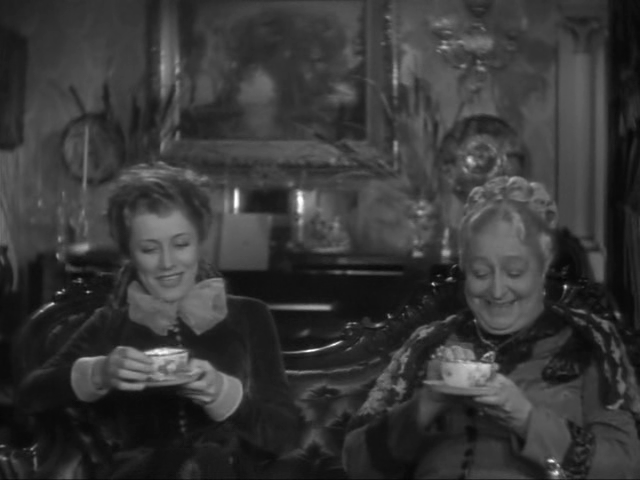
Irene with a lot of dispensable folks in the background

That this duck doesn't sink is mainly - once again - due to Miss Dunne who is not alone, because she has the support of a Kern score. I love Kern and I love Irene singing Kern, so this combination is a sure bet with me. “Lonely Feet” is one of my absolute Irene favorites and this beautifully staged grand number (choreographer Bobby Connolly) is quite a treat. Beyond the wonderful Kern songs, “Sweet Adeline” certainly has its moments: smashing close-ups of Irene especially while she is singing, and clever ideas of handling the camera. As so often the parts are better than the whole.

Miss Dunne singing Jerome Kern

This film cries for a lot of cutting and that's the reason why I won't write about Irene's colleagues here, they just ended on my personal cutting floor - at last I got rid of these distracting, but innocently so, folks. In a long interview with Irene in 1978 James Harvey used “Sweet Adeline” as an example: even in films “where nothing much seems to be at stake, or even to make much sense - what's striking is your intensity. It's one of the things that holds people when the watch your films.”

and more singing...

If Irene's intensity and a wonderful Kern score are reasons good enough for you to watch a film, those are notwithstanding the delicacies “Sweet Adeline” proffers between some tasteless courses.
Delicious or not - for everyone really interested in Miss Dunne, this film is virtually a must, because it marks her first Kern on screen. Considering how much Irene is associated with Jerome Kern's music that's an important Dunne moment, which shouldn't be missed.

Tuesday, September 28, 2010

The Age Of Innocence

Irene as Ellen Olenska

Release date 09.14.1934

“I'm not like these dear, kind people who want to help me. I want my freedom, Newland. I can't pretend…"
“Pretend?”
“Yes, that I'm like the other women over here. They never seem to feel any…need.
 …I'm one of those women who must have love…who must be loved.”
(Ellen - in the best scene of the whole film)

In a flashback Newland Archer (John Boles) tells his grandson about his love for Ellen Olenska (Irene) for whom he considered changing everything a long, long time ago…
Newland is engaged to May Welland (Julie Haydon) like him a member of New York's fin de siècle high society. This tradition centered community is entered by May's cousin Ellen who after living for a long time in Europe fled from her husband, and returned to her family seeks for a divorce now.

Ellen surrounded by her family

In the position of her legal adviser Newland gets the chance to talk her out of this, reminding her of the upcoming scandal and what this would mean for the rest of the family -there are more things to think about than Ellen's freedom and happiness. Nonetheless, Newland is touched by Ellen's honest directness and being different from all the other women in his surroundings, and slowly falls for her. Mixed up by these feelings he urges May to change her and her parents' plans and to marry as quickly as possible, which May interprets as a sign that he isn't sure about his love for her and offers to set him free. Something Newland declines thus dissipating May's hunch that he is interested in another woman.

For once alone...

For once alone, Ellen and Newland admit each other their love but only to be disturbed by a family uproar announcing the news that May persuaded her parents to hasten up the marriage.
Newland and May get married and embark for a long honeymoon in Europe. As soon as they are back they visit Granny Mingott (Helen Westley) who is kept company by Ellen. From the very first moment when they meet again it's obvious that nothing has changed between the two lovers. At one of their secret meetings at the Metropolitan Museum they decide to go to Washington together, but they make their plans without May and the relatives who started to get suspicious…

at the Metropolitan Museum...

Maybe if I wouldn't love Edith Wharton's novel of the same title on which this film is based, and wouldn't have watched the Scorsese filming of the “Age Of Innocence” a long time ago, I'd like this film better. But as things are, it's simply a bad filmization of that novel. The script deprives the story of all its delicately spun irony, its elegance and even its tragic moments, because the New York society Wharton portrays is one of unspoken dialogues, of undiscussed values and rules and certainly not as outspoken and direct as this film implies. This brings the story at the brink of not working at all because it's hardly understandable why these lovers can't be together. In the book this is all a lot more complicated and embroiled, which makes it understandable and not only an outlived, old-fashioned behavior. The utilization of a frame story in which the grandson in a similar situation decides just the opposite isn't helpful either. Bereft from all its subtlety the “Age Of Innocence” is simply an unhappy, weepy love story.

the last glimpse at Miss Dunne in this film...
Maybe even this could work - I can't say that I don't like a weepie now and then - if we would have a more competent leading man at hand. I complained about the handsome Mr. Boles in “Back Street”, but this time he really gets on my nerves in his one-dimensionality . Every time the miserable lovers meet, Mr. Boles looks at Irene like a wounded puppy, which obviously was meant to be tragic; added to this are corny violins in the background, which certainly is not Mr. Boles' fault, but that's just what I don't need having to face Mr. Boles in one of his emotional moments. Quite helpful once again are the supporting players who are around, especially Helen Westley as Granny Mingott - a real scene stealer - and Laura Hope Crews as May Welland's mother. Watching Irene's films the last couple of months I developed quite a liking for these two ladies.

Irene and the great Helen Westley - sharing an onscreen chuckle

This brings me to the lady for whom I'm around - Miss Dunne. Irene mainly gets me in this film - I have to admit this - with her looks. She radiates a warm, melancholy-trimmed, touching beauty, which is a real asset of this film and at last offers some depth and second layers to the goings-on. Her entrance - we have to wait ten minutes before she enters the screen - dressed up for a ball is glamorous and worthwhile waiting for. And there is Irene's lively, expressive face which once again made selecting the screenshots a real pleasure - certainly not my favorite film but good for wonderful photos. However, of course, Irene like the rest of the cast including Mr. Boles has to handle a weak, superficial script and they are not helped by the stiff and uninspired direction of Philip Moeller.

Irene as Ellen Olenska making an entrance and leaving an impression...

Well, it seems I don't like that film very much and what could I say about it?
Read the novel? That certainly would be an idea. And if you want merely to watch a good filming of it, turn to the Scorsese film from 1993 that by the way was nominated for an Academy Award for Best Adapted Screenplay.But if you are intrigued by Irene by now - and I kind of hope for that - switch “The Age Of Innocence” on - just to look at her.

Saturday, September 4, 2010

Detour - Remembering Irene

1940 - "My Favorite Wife"
                                          
It would be about time for the next review but another Irene event interfered: the 20th anniversary of her death date. We are busy with an Irene weekend, spending time together in chat rooms, watching Irene´s films sitting in different parts of the world. updating websites, up loading tributes...as long as Irene is remembered like that, we´ll skip the words "underestimated" and "forgotten". Maybe the Irene fans are not the biggest crowd out there, but, gee, something I learned the last couple of months, they are avid about that lady.
In honor of Irene I´ll update my website daily the next week, and don´t miss the wonderful tributes on YouTube created by the very young Irene fans Renata and Rocio.
And more news: lately Irene has her own FaceBook page managed by Janine. 

Irene Dunne - forgotten? No, Siree!!

Monday, August 23, 2010

Stingaree

                             Irene as Hilda Bouverie                           

Release date 05.25.1934

"Even a bandit must respect English womanhood! Why, the very foundation of empire is virginity!"
"Chastity, Madame, chastity! No empire would get very far with virginity!"

Good news for Mrs. Clarkson (Mary Boland): the famous composer Sir Julian Kent (Conway Tearle) from London is going to arrive soon at her Australian home. Convinced that she is an opera singer disguised as the wife of a rich sheep farmer, the only thing she got to do now is to prevent that her maid Hilda Bouverie (Irene) gets the chance to audition too, because Hilda is the real opera singer in disguise. Slightly disturbing all those plans is the highway gentleman bandit Stingaree (Richard Dix) who kidnaps Sir Julian planning to pose for him and so getting entrance to the wealthy Clarkson's house. When Stingaree shows up there, the only person around is Hilda practicing her singing. Stingaree instantly falls for the girl's beautiful voice, promises her to help her with a musical career and fittingly has a song at hand. The bandit posing as composer is indeed a composer!

Tonight is mine...

Soon after the return of the Clarksons Stingaree's real identity is revealed and he has to leave in a hurry but not without grabbing Hilda. On horseback they disappear into the bushes - literally.

  Hi-Ho...there we go!

Dammit! Sir Julian managed to escape Stingaree's valet Howie (Andy Devine) thus raining on Stingaree's parade who had a nice, very private audition for Hilda in mind.
Well, Stingaree will find another chance for her to sing for Sir Julian but not before he has shown Hilda that her voice is not his only interest in her…

 learning to love you, learning all about you!
  
The great day is here: Mrs. Clarkson performs for Sir Julian but soon he and the other guests are rescued by Stingaree forcing them at gunpoint to listen to Hilda instead. At gunpoint or not, Hilda sings beautifully “Tonight Is Mine” and Sir Julian impressed by her voice promises to take her to London to train her. Exit Stingaree, but this time his luck is against him and he is shot and imprisoned. Hilda is reluctant to leave but Stingaree insists on her putting her career first and “taking everything in her stride".

 Success, flowers and Hilda...

In the following years Hilda achieves indeed everything an opera singer can dream about - the public at La Scala and Covent Garden at her feet, fame, wealth and last not least the heart of her mentor Sir Julian. Nevertheless, Hilda can't forget Stingaree and she turns back for a gala performance in Melbourne. Will Stingaree show up there - conveniently he just escaped -  and will it be into the bush again  for Hilda??

real luck is on a horse's back

This film is an oddity, though a very entertaining one. While re-watching it I laughed a lot wondering if this isn't Irene's first comedy - in disguise of course. If I ought to take this plot seriously I just don't know what there is left to laugh about!
Mary Boland gives an over the top performance as wannabe opera singer and her audition for Sir Julian is hilarious, furnishing proof why singers have to practice in front of a mirror from time to time. Something Miss Dunne obviously did.

Don't forget the mirror!

In an interview in the 70s Irene remembered “Stingaree” mainly because of the opera singing she did in it and because she liked the torch song “Tonight Is Mine”- exactly the things I would remember about this film maybe with the addition that I always have a special liking for Irene's looks in period costumes. That lady certainly had a well-educated and trained voice and gets the chance to sing two arias. One is a part of the “jewel song” from Gounod's opera “Faust”, which Irene surprisingly sings a halftone flat than the original score. I really don’t know why - Irene's high notes don't sound like the limit of her voice to me here, but maybe she simply felt more comfortable singing it a little bit lower. Anyway, in the final analysis, we are in Hollywood and not on the stage of the Met or La Scala. 

Sir Julian, Annie and Hilda (Irene dressed in my favorite costume from this film)

The other one is an excerpt from Flotow's opera “Martha” and an original Irish song at the same time. Maybe Irene - mentioning her Irish origins frequently and obviously liking them - picked this one, but that's something we don't know. If I ramble on about Irene as singer and not so much about her as an actress, that's due to the fact that the outstanding part of this film for me is simply her excursion into opera. Beautiful enough - but Miss Dunne was where she belonged: in Hollywood. But of course I'm once again grateful that I decided on reviewing the films of an actress who offers me such diverse movies as “This Man Is Mine” and “Stingaree” in a row.
About Mr. Dix performance I want to quote the New York Post: “It is a preposterous tale, with Mr. Dix doing his best to prevent it from being even faintly credible.” (May 18. 1934) Couldn't have said it better - once again Miss Dunne is abandoned by her leading man. In the end,  Mr. Dix isn't much around anyway, only showing up in the beginning and the end of the film and in between pining away in some prison, unobserved by us though. To understand how the statuses of the two leads changed from their first enterprise together “Cimarron” (1931) to “Stingaree” one just has to look at the billing and how they are treated by the camera in their scenes together. Irene got first billing and a lot more attention from the photographer.

 Irene and the back of Mr. Dix's head

Don't ask me how director William Wellman - certainly worthwhile to know because of such films as “Public Enemy”, “Night Nurse” or “So Big” for instance - got involved in this project. But here he is, offering solid direction but having to handle an utterly unbelievable script. The funny moments are not unintentional -  just look what perspective Wellman selected for Mrs. Clarkson's audition for Sir Julian and you know that he wanted us to laugh. Similar are the performances of the supporting actors from the slightly drunk Inspector (George Barraud) till Hilda's maid Annie (Una O´Connor) prattling in a Cockney accent and Andy Devine in one of his typical sidekick roles.

once again  - tonight is mine....

“Stingaree” grew on me while re-watching it for this review, simply because I had so much fun - and I always
love when Irene sings. Additionally, I like the score from the “hi-ho we are riding bandit theme” to Mrs. Clarkson's ballad “The Fisherman” - with mermaids of course!

Here is the music!  

Friday, August 20, 2010

Detour - Miss Dunne and the Web, Irene on YouTube!

Hi folks!
(BTW that´s a publicity for "Lady In A Jam")
                            
YouTube is such a lively place at the moment when it comes to Irene, that I want to say some words about this: there are the loveliest tributes to be found, and a clique regularly uploads Irene´s  films.
I´m really happy about this because it allows an easy, low-threshold access to Miss Dunne´s films  - and they are certainly something to discover! Though being busy with old Hollywood for many years, it took a long time before I found Miss Dunne, that´s partly due to the fact that she is really not known in Germany, but yet, that such a talented, versatile representative of the golden era of Hollywood slipped me for so long startled me. However, don´t let Miss Dunne pass you by! There are many films up on YouTube now, which weren´t there when I reviewed them: "Ann Vickers" and "The Great Lover" for instance. 
All I can say now: watch them, watch them! And a big thanks to the up loaders!!  

Saturday, August 7, 2010

This Man Is Mine

Irene and Ralph Bellamy

Release date 04.13.1934             
                           
“Tony's pictures are exactly like her. You don't take much notice of them and all of a sudden you find they are having a terrific effect on you.” (Jim)
“She loves him for things like that!” (Bee)

An evening at the Dunlap's house: Tony (Irene) playing the piano - and it's a Steinway, folks - and her husband Jim (Ralph Bellamy) reading. Better trying to read if his wife would only let him instead of making noisy things or talking to him about the plans for their son's future, which is really an urgent topic considering the fact that Jeremy is already in the advanced age of two. 

 spending a cosy evening at home

This idyllic matrimonial banter is disturbed by the Dunlap's good friends Bee (Kay Johnson) and Jud McCrea (Charles Starrett) popping in for a drink and a word with Jim. A ghost from Jim's past is going to emerge - not from the grave but from Reno - in the person of Fran (Constance Cummings) Jim's former fiancee who eloped immediately before the wedding and happens to be Jud's sister. Man eater Fran on her way - that's certainly worth a warning for Jim and some kind of preparation for Tony...

" Tony, what do you know about me?"
"You'd be surprised!"

Soon we learn that Tony knows everything about Fran, town's gossip took care of that in the last years, and that she is sure of her and Jim's love. A love Tony appreciates even more because she had a very uneasy childhood as kid of a painter and a Prima Donna who not only playing the femme fatale on stage at last eloped with the tenor and thus ruined Tony's father's career. Tony is herself a painter whose landscape paintings reflect her wish for nothing more than her calm life with Jim and Jeremy.

Fran (Constance Cummings) is back in town!

Of course this very settled life is soon disturbed by Fran who with a dubious man in tow not only dazes Jim but almost every man around. Poor, stupid Jim can't help it and falls for Fran again, seriously enough - at least from his side - to ask Tony for a divorce. But, well, Tony isn't the person to give up so easily and if there is going to be a divorce it's going to be on her terms with naming Fran as correspondent and suing her for a million dollars for alienation. Not exactly what Fran had in mind starting that little fling with Jim…

the triangle

Up for a conversation piece of a film? True to its definition of depending chiefly on its wit of dialogue, taking place in upper-class circles and getting the action started through occurrences from without? “This Man Is Mine” made me laugh, touched me sometimes (Miss Dunne took care of that) and made me smile about the stupidity of mankind. If we are not confronted with real problems - some existential ones for instance - we are all good at inventing some trouble on our own. The film touches with a light hand the question if real happiness is contentment - or let's say the kind of happiness which offers some lasting quality - and shows how quickly human relationships change and leave us on a very slippery ground. 

 losing a life and trying to be brave about it...

Certainly the characters are well-known ones: the husband not really appreciating the beautiful, painting, singing, piano playing, heart of gold wife of his - which REALLY makes you wonder what men are looking for - the all enduring wife fighting for her little niche of the world, and of course femme fatale Fran. She is a cliché on legs - manipulative and phony as can be, but she meets her male match - someone she thinks even she may not be able to handle - in the end, which is one of the nice tidbits of the film. However, the whole thing is really entertaining with some great lines of dialogue and an in its entirety very well picked cast.

no crisis without a friend (Kay Johnson) 

I especially like Kay Johnson as Irene's sidekick soberly commenting the happenings and at the same time being true to her friend Tony. I have always a weakness for these kind of characters so wonderfully represented by actresses like Kay Johnson, Jean Dixon and Eve Arden of course - just to name a few. This is the first time that Ralph Bellamy and Irene shared the screen and for once he is her leading man and not the third part of a triangle and the second male lead. Bellamy does a good job but simply isn't in Irene's league of acting, he just doesn't move around in that range of capabilities of expression, which brings me once again back to Miss Dunne. 

 At last Tony is losing her temper...

There is a lot more about Tony than just being the “little wife” though she is initially presented like that, and Irene squeezes out of that role what there is to squeeze. From a restraint reaction to Jim's wish for a divorce - Irene plays that consequently at the brink of a breakdown which is really touching - to the end when Tony hits Jim with one of her paintings over the head - about time for that and the prelude to their reconciliation. In hindsight and with the knowledge of the comedies to come this scene gets a quality of its own.
“This Man Is Mine” teams Irene the third time with director John Cromwell and once again I admire the way how he handles the close ups, finds interesting camera angles and keeps the whole film in a fine balance.
This is not a great, "must see" film but if you are in the mood for a rather talkative, stagy movie, with great acting , some  comic dialogue and touching lightly some serious topics, this could be the choice for the evening. But if you are a Dunne enthusiast, this film is simply a must.

and another close up...

Leaves my Irene tidbit: there is a very, very short scene in which Irene chews gum - a habit normally reserved for dubious girls in that film era. If I needed a hint that Tony has some “tough cookie” qualities there it is - not solely about roses and lavender that lady!

Wednesday, July 21, 2010

If I Were Free

Irene as Sarah Cazenove

Release date 12.01.1933

“Who would care to be found dead in a ditch with you!?”
Tono (Nils Asther) to Sarah (Irene)

Sarah Cazanove (Irene) has the nerve to deny her husband Tono (Nils Asther) to play the chaperon for him and his mistress. Tono Cazanove - what a meaningful second name - then threatens to shoot her, but before he comes around to that, some guests arrive for cocktails. Instead of murdering her Tono simply leaves his wife letting her to her guests and this utterly embarrassing situation. Sarah tries to commit suicide but is stopped by one of the guests - a lawyer named Gordon Evers (Clive Brook) who has his own share of unhappy marriage. He encourages Sarah to come to London with him and to start a new life.

Sarah and Tono (Nils Asther)

We are heading in the direction of the first happy interlude, which shows us Sarah at the opening day of her interior decorating shop and business. Being a happy divorcee Sarah answers to Gordon’s “If I were free …” question with a very romantic “I considered marriage for quite some time now…” End of first happy interlude.

first happy interlude - "If I were free..."

Often film wives are not really interested in their husbands, but they don’t want to divorce them either. Katherine Evers (Lorraine McLean) is not an exception to the rule, and refuses Gordon a divorce, especially because under Sarah’s loving influence Gordon started earnestly working on his career again. Though marriage is out of reach at the moment the couple decides to go on with their relationship anyway - we are still in the pre-code era, so that’s allowed.

second happy interlude

The second happy interlude is a trip to a romantic country spot, which gives Irene the chance to sing, but more problems are already arising at the horizon. One pops up in the person of Gordon’s friend Hector (Henry Stephenson) claiming that Gordon’s liaison with Sarah interferes with Gordon’s career. As we know, true love is sacrificial and thus Sarah decides to leave Gordon writing him a farewell letter. As if this wouldn’t be enough Gordon has to face a severe surgery because of an old injury he got in WW1 -  with a chance of surviving from a hundred to one…and where is Sarah?!

Henry Stephenson as problem and capable sidekick

After “The Silver Cord” and “Ann Vickers” this film is quite a decline, and looking at my plot summary it seems I just don’t manage to be serious about it. “If I Were Free” just doesn’t work - it’s not a real romance, it’s not a real weepie, it offers no real challenge of any kind for Miss Dunne - maybe with the exception to have to act a romantic entanglement with such a wooden actor as Clive Brooks who creates his role with facial expressions from A to B. Consequently, his most convincing scene is the one showing him still half anesthetized after the surgery. At least at that moment Irene starts to sing again - she sings two times the lullaby "Schlafe, mein Prinzchen"  in German, which is after all a nice tidbit.

Sarah singing for Gordon  - because of therapeutical reasons

The fact that director Elliot Nugent offers no interesting angles and that the “if I were free…” love scene is badly out of continuity edited, isn’t helpful either. It’s a mediocre filler of a film and a waste of Irene’s talent. If there is something worthwhile watching it’s the beginning. The few scenes Irene has with Nils Asther, because she makes the humiliation of a woman - whose husband adds insult to injury - touchingly perceptible. Leaves the problem that Tono’s thesis that Sarah isn’t attractive at all - even dead you wouldn’t want to be found with her - looking at Miss Dunne isn’t really convincing. What a pity that we don’t get to see his mistress!

Sarah and Gordon´s mother (Laura Hope Crews)

To end this on a positive note - there are some old, capable acquaintances around like Laura Hope Crews as Gordon’s mother and Henry Stephenson contributing as Gordon’s sidekick.

Well, if I ever would have to pack my “Irene bag for the island” with a limited amount of luggage I’d leave “If I Were Free” behind on the mainland…

However, have a look for yourselves:

Here is part one!

Tuesday, July 6, 2010

Ann Vickers

Ann after she lost her daughter
                                                          
Release date 10.06.1933

"...I named her too...None of those meaningless names they use today...but I found a modern virtue to name my daughter - pride! The pride of life, the pride of love, the pride of work, the pride of being a woman. Those would be her virtues - Pride Vickers!"

Dedicated social worker Ann Vickers (Irene), though claiming that she isn’t ready for love yet, falls for Captain Lafe Resnick (Bruce Cabot) who she meets at a settlement’s house dance. It’s the time of WW1 and Lafe is at the brink of leaving for France, which gives the couple about two weeks. Lafe proposes to Ann who rejects him for the time being but promises to marry him as soon as he´ll come back.

meeting Lafe (Bruce Cabot)...

This whirlwind of two weeks is ended by Lafe’s departure and soon the incoming letters are less often and distant in tone. Ann is pregnant and when she confronts Lafe with this fact it’s obvious that marrying her only would be a duty for him, which Ann firmly spurns. Like a bubble, her last emotions for Lafe burst and destroy her being in love with an idea of a man and not with the man himself. From now on it’s going to be her career and her child - she is sure it will be a daughter - for Ann Vickers.

at Copperhead Gap Prison...

Ann loses this child - her dreamed of and about daughter - which only leaves her the career. She decides to do it the hard way and to work for some time at the Copperhead Gap Prison. This place is hell on earth, with brutal inhuman treatment of the prisoners.
When Ann tries to fight those conditions, she is blackmailed into a resignation by the director and the main ward of the prison. This doesn’t stop Ann from writing a book about her experiences that becomes a bestseller.

at the Stuyvesant Home For Women

At last, Ann gets the chance to try out her own reforming ideas as director of the Stuyvesant home, a reformatory home for women. Ann is successful but lonely - until she meets Judge Barney Dolphin (Walter Huston) at a party, a man with whom she dealt professionally several times but hadn’t met yet. From the very start, their relationship is something special - the fitting physical and mental match. Barney is married to a woman, who prefers Europe to her husband’s company, and thus Ann and he have to keep their tie a secret.

meeting Barney (Walter Huston)...

Nevertheless, Ann’s pregnancy is highly welcomed by the couple and the birth of their son Matthew makes the bond between them even deeper. But there is not much time to enjoy their togetherness - Barney is accused of being bribed by taking stock tips from criminals and sentenced to a six-year penalty. Suddenly Ann founds herself not only in love with a man exactly being the kind of dishonest official she fought all her life but being placed on the other side of the bars. After losing her work because of her private life Ann manages to make a living with writing articles on prison reform and she waits for Barney…


Barney as prisoner...

This time the plot summary was a rather difficult task because it’s an interesting and rather complex storyline and I tried not to go into too many details because that’s a movie I decidedly want you to watch.
It’s a film about a woman on a search, someone who wants to better the world - “even if it takes the whole winter” as Ann is described by her friend Marvinia Wormser (Edna May Oliver) -  a film about humanity, about principles and about how our principles affect our humanity and vice versa. Ann is surrounded by three men of importance : Lafe who makes the impression of a sensitive, honest man but is a scoundrel at heart, Lindsey (Conrad Nagel) a lawyer-judge friend of Ann who stands for bloodless harping on about principles, and Barney who is the convicted rascal but the most honest and complete person of this triangle. Even the rather conventional, conservative end which finishes Ann’s search with the turning to her man and son - fitting not only for a women’s film of this era but also according to the novel by Sinclair Lewis - is an act of personal integrity and as such just the consequent end of this film.


visiting Barney in jail...

These very human topics are embedded in a very well made film, with an at times almost naturalistic quality. Especially impressing is director Cromwell’s use of close-ups, which he utilizes to add intensity to dialogue by calmly switching from face to face - thus not only adding emphasis to a scene but bringing the story to a significant moment of rest. Once again we are moving on a quick path and there is a lot to tell in only 72 minutes but by using clever perspectives like the cross-fade of Irene´s face for the scenery in the prison, director Cromwell avoids any feeling of breathlessness.


hell on earth...

This time Irene has in the person of Walter Huston a real leading man to play with, and together they make a wonderfully adult couple, falling head over heels for each other but still with wide-open eyes for the consequences. Indeed in their naturalness together and how Irene and Walter Huston pull that off, we forget about the fact that this is an adulterous affair with an illegitimate kid - certainly not the normal social standard - and of course pre-codish as can be. Pre-martial sex, pregnancy out of wedlock - not only once but twice - illegitimacy and corrupt law that’s a nice “ pre-code medley“.
“Ann Vickers” is centered on Irene and she gets the chance to embody a full-fledged personality with very different aspects and sides - and as we know by now if there was a chance to take, Irene took it. None of her peers has a real extensive part, even Walter Huston merely turns up in the last third of the film.

publicity for "Ann Vickers"

This film has a special place in my own personal Dunne history -  as so many, I started with one of Irene’s comedies liking it enough to check out other Dunne films. One of those following films was “Ann Vickers” and after that one, I knew that I had to watch all of Miss Dunne´s available movies - which I did. Moreover, another thing began after watching this film: I started to pay attention to how Irene uses her hands and she does the most impressive, meaningful things with them…

Don’t miss that film if you get the chance to watch it, because it’s an utterly interesting story, because it’s a prime example of a pre-code and of old Hollywood craftsmanship and - last not least - because it’s such a wonderful Irene Dunne movie!

That´s director John Cromwell, and he deserves to be shown!

Here is still a nice tidbit for you: the soldier longingly staring at Irene at the settlement’s house dance is director John Cromwell…it seems not only Hitchcock did show up in his own films!